
One experiment. One question. And then another.
Sometimes a creative experiment doesn’t begin with a plan.
It begins with a small question:
What if…?
Recently, I found myself exploring what happens when Gelli Plate prints, vintage papers and rice paper are combined.
It started quite simply.
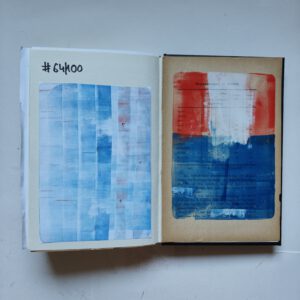
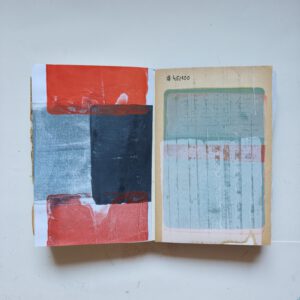
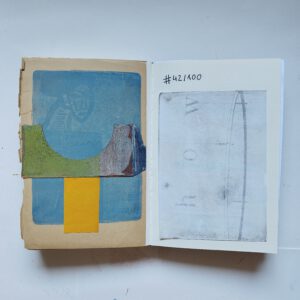
I began printing directly onto vintage papers. I love the marks, typography and subtle details that remain visible underneath the paint. The old paper becomes part of the print rather than just a surface to print on.
But then another idea appeared.
What would happen if I put a Gelli Plate print on rice paper and layered it over the vintage paper?
I tried it.
And I loved what happened.
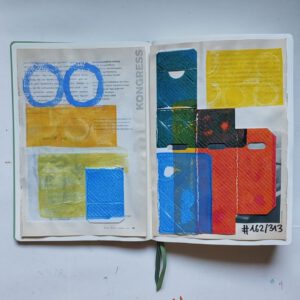
Because rice paper is translucent, parts of the vintage paper remain visible through the print. The result feels like a collage, but unlike a traditional collage, the printed layer covers the entire surface.
The old paper and the new print become one image.
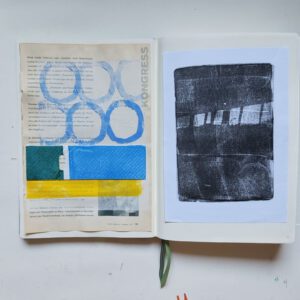
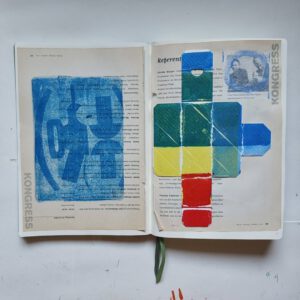
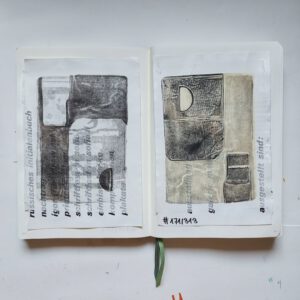
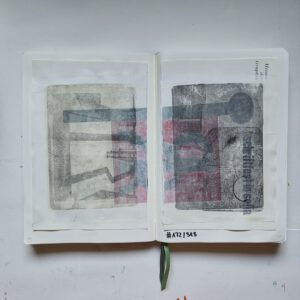
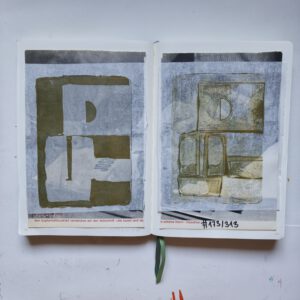
From one question to the next
Once I had made a few of these, I started wondering:
What if I used one of my own Gelli Plate prints underneath instead of vintage paper?
So I began using some of my stronger first prints as the base.
Then I added a more subtle Gelli Plate print on rice paper on top.
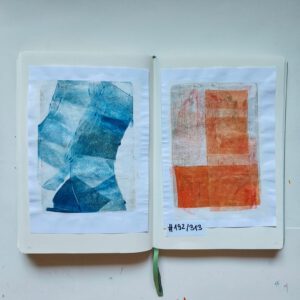
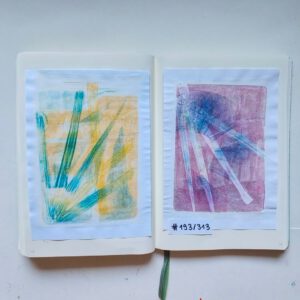
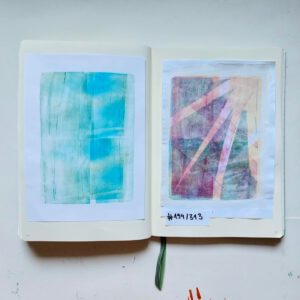
I started playing with different colour relationships.
Strong against subtle.
Dark against light.
Similar colours.
Unexpected contrasts.
And suddenly I wasn’t working on one particular finished piece anymore.
I was experimenting.
I don’t always know where an experiment is going
This is one of the things I enjoy most about working with the Gelli Plate.
I don’t need to know what the finished piece will look like before I begin.
I can start with one small idea and see what happens.
If something surprises me in a good way, I follow it.
I make another print.
I change one thing.
I look again.
And then another question might appear.
That’s how a five-minute experiment can sometimes turn into something that keeps me interested for days.
And sometimes it doesn’t.
Sometimes I make a few prints and decide that the idea isn’t going anywhere.
That’s useful, too.
I’m not trying to make every experiment successful.
I’m trying to find out what interests me.
The unexpected part
What I find particularly fascinating about layering rice paper over another print is the way the layers interact.
The rice paper softens the image underneath while still allowing parts of it to show through.
Strong shapes become quieter.
Colours mix optically.
Details appear and disappear depending on what is underneath.
And because every print is slightly different, the result can’t really be planned.
That’s exactly what makes me want to keep experimenting.
What happens if…?
This experiment is still developing.
At the moment, I’m exploring rice paper prints layered over my own Gelli Plate prints.
And it already makes me wonder what could happen next.
What if I used a completely different colour relationship?
What if the print underneath was very strong?
What if it was almost monochromatic?
What if I used papers I find while travelling?
I don’t know yet.
And I don’t need to.
Sometimes the question is more interesting than the answer.
A creative practice doesn’t have to move in a straight line
This is something I’ve learned from making regularly.
An idea doesn’t have to be finished before you move on.
You can return to it later.
An old experiment can become the starting point for a new one.
A technique you discovered months ago can suddenly make sense in a completely different context.
Things come and go.
And then they come back.
The more you make, the more these experiences begin to connect.
One experiment becomes material for the next.
And sometimes a simple What if…? is all you need to begin.
Want to try it?
You don’t need a complicated project.
Take one of your Gelli Plate prints and a piece of rice paper.
Make a simple print on the rice paper, let it dry, and place it over your original print.
See what remains visible.
Try another colour.
Try another print.
Move the layers around.
And notice what catches your attention.
You might stop after five minutes.
Or you might find yourself still experimenting half an hour later.
There is no right result.
Just a question, a print, and the next small experiment.