
Look around. Look closer. Make a trace.
I’m currently spending a couple of days at the North Sea, and of course my Gelli Plate came with me.
One of the things I love about keeping a daily creative practice is that it doesn’t have to stay at my usual desk. I can take it with me and use whatever I find around me as a starting point.
Being somewhere different changes what I notice.
The colours are different. The shapes are different. There are plants, textures, marks, objects and little details that I might normally walk past without really seeing them.
So while I’m here, I’ve been experimenting with a simple question:
What happens when I look at my surroundings through the eyes of a printmaker?
Here are seven simple ways I’ve been using what I find around me to make Gelli Plate prints for my Sensory Diary.
What is a Sensory Diary?
For me, a Sensory Diary is a way of keeping a visual record of where I am and what I notice.
It isn’t about creating a beautiful artwork every day.
It’s about showing up, making something small and leaving a trace of the day.
A colour, a shape, a texture, a found object or something I happen to notice can become the starting point for a print.
Sometimes I have a very clear idea of what I want to make.
Sometimes I have absolutely no idea.
And sometimes the simplest print becomes the starting point for something much more interesting later.
You don’t need to know what you’re going to make before you begin.
01 – USE OLD PACKAGING
Look at what you already have.
When I’m travelling, I don’t bring lots of fancy printing materials with me. I like looking at what is already around me.
Packaging is particularly interesting because it often has unexpected shapes, edges and textures.
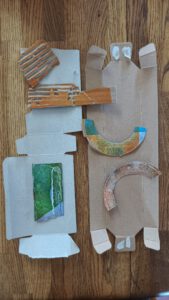
Instead of throwing it away, I can cut it apart and use the pieces as tools, masks or printing elements on my Gelli Plate.
I made several prints from the packaging I found here. I chose one to show here:
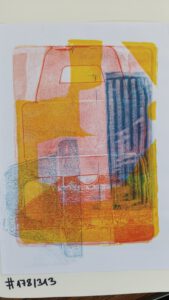
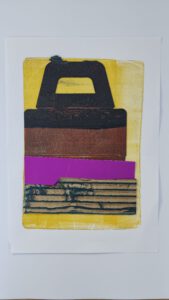
I like the fact that something completely ordinary can become part of the visual language of a print.
02 – LOOK AT PLANTS
What shapes and textures do you notice?
There are plants everywhere when you start looking.
Here at the North Sea, I noticed the reeds growing around us and started wondering what would happen if I translated their shapes and textures into a print.
I don’t need to reproduce the plant realistically.
I’m more interested in its rhythm, movement, structure and the marks it can leave behind.
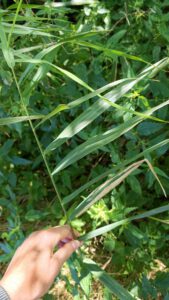
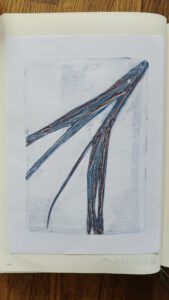
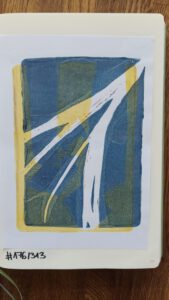
It only needs to carry something from the experience of noticing it.
03 – LOOK FOR MARKS
Footprints, cracks, scratches, lines, stains…
Once you start looking for marks, you begin to see them everywhere.
I noticed the little footprints left by seagulls and decided to draw them onto my Gelli Plate print.
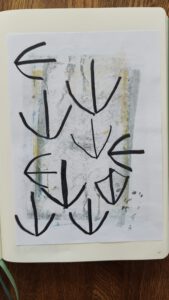
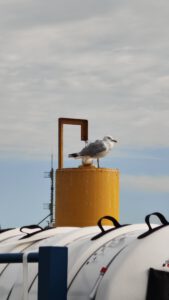
It made me think about how many traces we normally overlook.
A mark doesn’t have to be beautiful or interesting on its own.
It can simply be a starting point.
04 – LOOK FOR SHAPES
Notice the shapes in the places around you.
Sometimes I don’t need to look for an object at all.
I can simply look for an interesting shape.
In the old farmhouse where we’re staying, I noticed the shape of a window with a vase standing in front of it.
I photographed it and used those shapes as the starting point for a print.
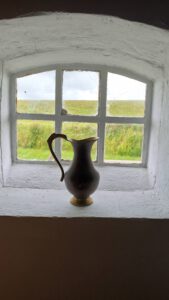
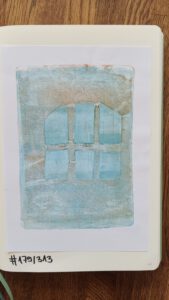
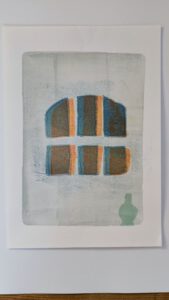
I love this kind of translation.
The original thing disappears and becomes something much more abstract.
05 – LOOK DOWN
Interesting shapes might be right under your feet.
Sometimes you just have to change your point of view.
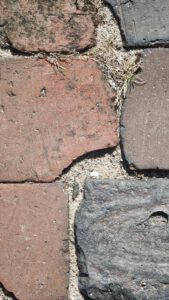
I’ve walked over these paving stones many times without really noticing their shapes.
But once I started looking at them with the intention of making a print, I saw their pattern differently.
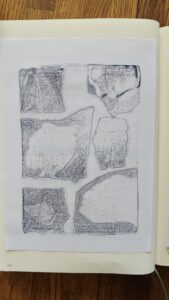
This is one of my favourite things about a sensory diary.
It makes me pay attention to things I might otherwise overlook.
06 – FIND FACES
What characters are hiding in your prints?
This one is a little different.
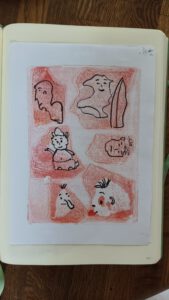
Instead of looking at the world around me, I look closely at the print itself.
Sometimes shapes and marks begin to look like faces or little characters.
I can draw them in, emphasize them or simply notice them.
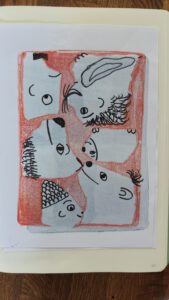
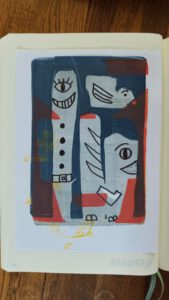
There doesn’t have to be a face there.
The fun is in seeing what your brain discovers.
And once you start looking, you may never see your prints quite the same way again.
07 – BORROW THE COLOURS
Take a colour palette from the place you’re visiting.
You can also use the colours around you as a starting point.
I looked at the sea, the sand and the vegetation around me and noticed a combination of blues, greys and greens that I wanted to explore.
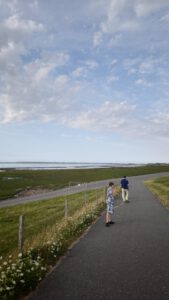
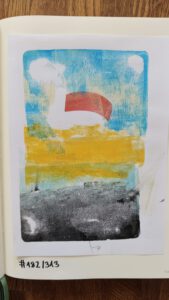
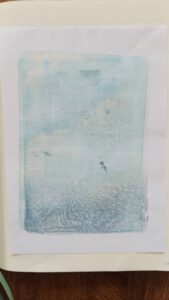
I didn’t try to reproduce the landscape.
I simply borrowed its colours and translated them into my own language.
You don’t have to match the colours exactly.
Just notice a combination that speaks to you and see what happens when you bring it onto the Gelli Plate.
THE POINT ISN’T THE RESULT
Some of my prints work beautifully.
Some don’t.
Sometimes I start with a very clear idea and the result is disappointing.
Other times I make something in five minutes simply because I don’t feel like doing anything else — and that print becomes the beginning of something I really love.
That’s one of the reasons I keep making.
The practice isn’t about controlling the outcome.
It’s about staying open to what might happen.
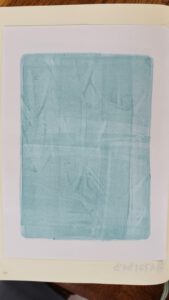
And on the days when I have absolutely no inspiration, I can make something as simple as a colour field.
It takes less than five minutes.
I can put it in my diary and move on.
Sometimes that’s all I do.
Sometimes that tiny print becomes the beginning of something else.
A small print is enough to keep the practice going.
MY GELLI PLATE TRAVEL KIT
Everything I need to keep the practice going while I travel.
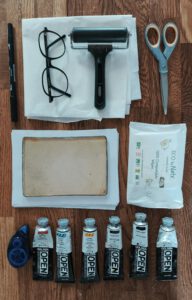
I BROUGHT
A small A5 Gelli Plate · A5 copy paper · a brayer · six colours · wet wipes
KEEP THE PRINTS YOUR MIGHT NEED LATER
An archive of possibilities.
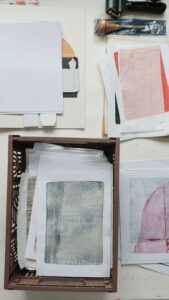
I usually make more prints than I put into my diary.
I archive them in a box and I go through it from time to time and look at the prints again.
Sometimes I’m looking for something that could become another layer.
Sometimes I find fragments that would work beautifully in a collage.
Sometimes an old print suddenly makes sense next to something I have just made.
I don’t have a strict system for deciding what stays.
Some prints I know I want to see again.
Others simply don’t interest me anymore, and I let them go.
I decide by feeling.
CONNECTING DIFFERENT DAYS
This is probably one of my favourite parts of the whole practice.
An old print doesn’t belong to the day on which it was made.
It can become part of something completely new.
I once asked:
What happens when you combine the print from Day 8 with the print from Day 82?
The answer might be a collage on Day 126.
And that is what makes this practice so personal.
Nobody else has your collection of prints.
Nobody else has made those particular marks, colours and decisions on those particular days.
The more you make, the more material you have to respond to.
You don’t have to start from a blank sheet every day.
You can start from something you have already made.
And sometimes the connections between different days are where the most interesting things happen.
YOU DON’T NEED A STUDIO
This is one of the things I love most about this practice.
It travels.
I can make a Sensory Diary at home, at the North Sea or somewhere completely different.
The practice stays the same.
The surroundings change.
In October, I’ll be travelling to Catania with a friend, and I’m already wondering what I will notice there.
Different colours.
Different architecture.
Different packaging.
Different plants.
Different textures.
Different marks.
I don’t know yet what those things will become.
And I don’t need to know.
The place I’m in can become part of the diary.
START WHERE YOU ARE
You don’t need a perfect idea.
You don’t need a studio.
You don’t need to be able to draw.
And you don’t need a lot of time.
You can start with a piece of packaging.
A plant.
A footprint.
A window.
A paving stone.
A colour.
Or simply a blank Gelli Plate and whatever happens next.
The point isn’t to make something impressive every day.
It’s to keep looking.
To keep noticing.
To keep making.
And to give yourself the opportunity to discover what happens when you do that again and again.
Look around.
Look closer.
Make a trace.
WANT TO EXPLORE THE SENSORY DIARY?
I’m currently developing a more detailed guide to my Sensory Diary practice with the Gelli Plate.
It will bring together the ideas, ways in, prompts and principles that have grown out of my own daily practice — including what to do when you have no inspiration, how to use old prints as starting points and how a regular creative practice can help you develop your own visual language.
If you’d like to hear when I publish new creative resources, projects and guides, you can join my newsletter.
JOIN MY NEWSLETTER →
When you join, you’ll also receive my free guide: Staying, Time & Direction.